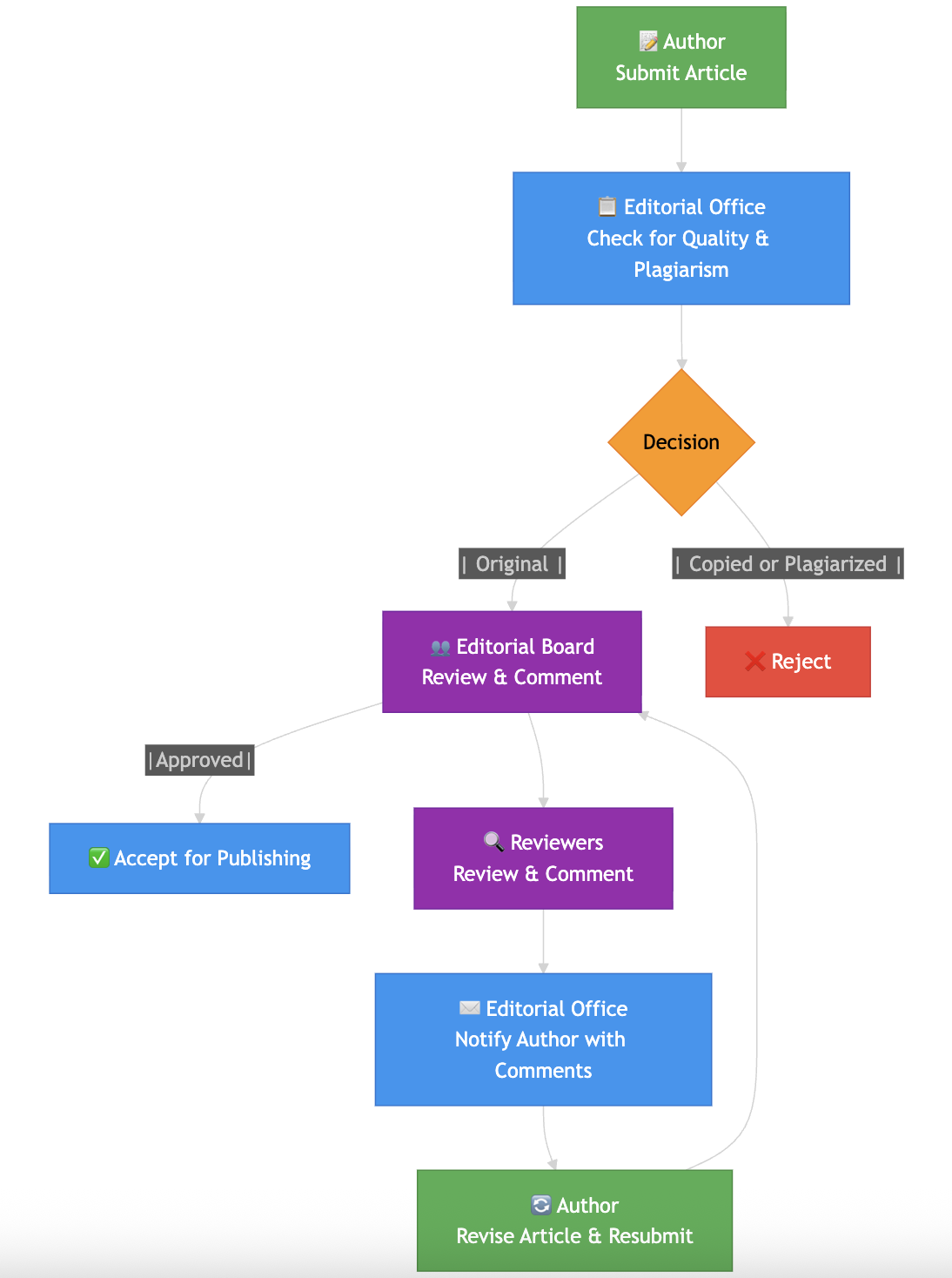
Editorial & Publication Information
60 Days
Typical Time to Final Decision
English
Publication Language
Single-Blind
Peer-Review Model
The stated decision time and acceptance rate are journal-level indicators
and may vary over time. Editorial decisions depend on manuscript quality,
scope relevance, methodological and ethical assessment, reviewer
availability, revision requirements, and author response times.
Similarity screening forms part of the journal's editorial assessment
and is not interpreted solely on the basis of a numerical similarity score.
About the Journal
Overview
The Journal of Women’s Clinical Health Research is an international, peer-reviewed, open-access journal dedicated to the publication of scholarly research concerning women’s health across the lifespan. The journal provides a scholarly platform for clinicians, researchers, healthcare professionals, educators, and other contributors to communicate research findings and scientific developments in women’s clinical health.
Women’s clinical health encompasses a broad range of biological, psychological, social, environmental, and healthcare-related factors that influence health and disease across different life stages. The journal welcomes research addressing reproductive and gynecological health, maternal and fetal medicine, mental and behavioral health, hormonal and metabolic health, cardiovascular health, osteoporosis, gynecologic oncology, breast health, chronic diseases, preventive medicine, public health, and related clinical and interdisciplinary areas.
The Journal of Women’s Clinical Health Research welcomes original research articles, clinical studies, review articles, systematic reviews, case reports and studies, short communications, policy perspectives, and other scholarly contributions appropriate to the journal’s scope.
The journal also encourages research addressing sex- and gender-related differences in health, healthcare access and disparities, social and environmental determinants of women’s health, digital health, precision medicine, patient-centered care, and other emerging areas relevant to clinical practice and public health.
Manuscripts are considered in accordance with the journal’s scope, editorial policies, ethical requirements, author guidelines, and peer-review procedures. The editorial process includes appropriate assessment of manuscript originality, scientific relevance, methodological considerations, ethical compliance, and suitability for publication.
The journal is committed to responsible scholarly communication, research integrity, transparent editorial practices, accurate publication metadata, and the responsible dissemination of research in women’s clinical health.
Aim and Scope
The Journal of Women’s Clinical Health Research is an international, peer-reviewed, open-access journal covering clinical, translational, interdisciplinary, and public-health research concerning women’s health across the lifespan, from adolescence through older adulthood. The journal welcomes research addressing sex- and gender-related health differences, clinical practice, healthcare delivery, prevention, and related scientific and societal dimensions of women’s health.
We welcome submissions in, but not limited to, the following areas:
Reproductive, Sexual & Gynecological Health
- Menstrual health, adolescent gynecology, and reproductive endocrinology
- Polycystic ovary syndrome (PCOS), endometriosis, uterine fibroids, and pelvic inflammatory disease
- Infertility evaluation, assisted reproductive technologies, and reproductive outcomes
- Contraception, family planning, and sexual health education
- Sexually transmitted infections (STIs), HPV, HIV, and vaginal microbiome research
- Pelvic floor disorders, urogenital health, and sexual dysfunction
Maternal, Fetal & Perinatal Medicine
- Pregnancy care, antenatal monitoring, and obstetric management
- High-risk pregnancies, maternal morbidity and mortality
- Fetal development, prenatal screening, and diagnostic technologies
- Maternal nutrition, metabolic health, and maternal-fetal interactions
- Postpartum recovery, lactation, and maternal mental health
Chronic Diseases & Clinical Conditions in Women
- Cardiovascular diseases, hypertension, and stroke in women
- Diabetes, obesity, and metabolic disorders
- Autoimmune and endocrine disorders with sex-specific presentations
- Infectious diseases affecting women across the lifespan
- Pain disorders, chronic fatigue, and multisystem conditions
Women’s Oncology & Breast Health
- Breast, ovarian, cervical, and endometrial cancers
- Screening, early detection, and prevention strategies
- Benign breast disorders and clinical breast health
- Survivorship, rehabilitation, and quality-of-life research
Mental, Behavioral & Psychosocial Health
- Depression, anxiety, and stress-related disorders
- Perinatal and postpartum mental health
- Substance use disorders and behavioral interventions
- Psychosocial, cultural, and environmental determinants of health
Aging, Midlife & Menopause
- Menopause, perimenopause, and hormonal transition management
- Osteoporosis, musculoskeletal disorders, and frailty
- Cognitive aging, dementia, and neurological health
- Healthy aging, preventive care, and geriatric syndromes
Public Health, Global Health & Health Equity
- Gender-based health disparities and social determinants of health
- Access to healthcare, rural and underserved populations
- Global women’s health and cross-cultural perspectives
- Gender-based violence, trauma, and community interventions
- Health systems, policy analysis, and women-centered care models
Sex-Specific & Precision Medicine
- Sex-based biological differences in disease mechanisms
- Clinical pharmacology and therapeutic responses in women
- Precision medicine and individualized treatment strategies
- Gender-sensitive clinical trial design and outcomes research
Clinical Interventions, Surgery & Rehabilitation
- Gynecological and obstetric surgical techniques
- Minimally invasive and robotic-assisted procedures
- Postoperative care, rehabilitation, and recovery
- Pelvic floor physiotherapy and functional restoration
Women’s Wellness, Lifestyle & Preventive Medicine
- Nutrition, diet, and metabolic health
- Physical activity, lifestyle interventions, and preventive care
- Screening programs and early disease detection
- Occupational health, environmental exposures, and toxicology
Digital Health & Emerging Innovations
- Telemedicine, mobile health, and wearable technologies
- Artificial intelligence and data-driven healthcare in women
- Digital interventions for prevention, diagnosis, and management
- Ethical considerations, patient advocacy, and gender equity
Inclusive & Diverse Women’s Health
- Adolescent and young women’s health
- LGBTQ+ and gender-diverse populations
- Cultural, societal, and behavioral influences on women’s health
The journal welcomes original research articles, clinical studies and trials, systematic reviews, review articles, case reports and studies, short communications, policy perspectives, methodological contributions, and other scholarly submissions appropriate to its scope.
The journal particularly welcomes research that connects basic science, translational research, clinical practice, public health, healthcare delivery, and health policy, as well as studies addressing important women’s health questions across diverse populations and settings.
Through peer review and open-access dissemination, the Journal of Women’s Clinical Health Research supports the responsible communication of scientific findings and scholarly knowledge among researchers, clinicians, healthcare professionals, policymakers, and other relevant stakeholders.
Editorial and Peer-Review Policy
Journal of Women's Clinical Health Research
follows the editorial and peer-review procedures described in the
journal's policies and author guidelines. Manuscripts are assessed
for relevance to the journal's scope, originality, scientific merit,
methodological considerations, ethical compliance, and suitability
for publication.
Key features include:
-
Manuscripts are evaluated by appropriate reviewers and/or editors
with relevant subject expertise, according to the journal's
stated peer-review model.
-
The applicable peer-review model and reviewer confidentiality
arrangements are described in the journal's policies.
-
Editorial assessment considers scientific relevance, originality,
methodological quality, ethical compliance, and alignment with
the journal's scope.
-
Manuscripts undergo appropriate originality, plagiarism, and
research-integrity checks before or during the editorial process.
-
Final publication decisions are made by the responsible editor
in accordance with the journal's editorial policies and the
outcome of the applicable review process.
Publication Frequency & Format
The journal's publication frequency is
Annual (One issue per year).
Accepted articles are made available online in HTML and PDF formats
following completion of the applicable editorial and production processes,
supporting accessible and timely dissemination of published research.
Open Access Policy
Journal of Women's Clinical Health Research
operates under an open-access publishing model. Published content is
freely accessible to readers without subscription or paywall
restrictions, subject to the applicable journal policies and licensing
terms.
Copyright, licensing, and reuse rights are governed by the terms
specified for the journal and individual published content.
Indexing & Archiving
The Journal of Women's Clinical Health Research
seeks to make its published research discoverable through appropriate
scholarly indexing, abstracting, and discovery services. Inclusion in
any external indexing or abstracting service is subject to the
eligibility requirements, evaluation procedures, and acceptance
decisions of the respective service.
The journal is committed to maintaining accurate article metadata,
persistent identifiers, accessible article landing pages, and the
continued availability of published scholarly content.
Information about indexing, abstracting, discovery, and preservation
services is provided on a service-specific basis and is updated when
the relevant status has been established and verified.
Manuscript Submission
Authors are encouraged to submit their manuscripts through the journal's Online Submission
System (Submit Manuscript).
Manuscripts must adhere to the journal's author guidelines regarding structure, formatting,
referencing style, ethical approvals, and necessary disclosures (such as conflicts of interest
and funding).
Publication Ethics & Integrity
Journal of Women's Clinical Health Research follows internationally recognized standards for publication ethics and research integrity,
which include (but are not limited to):
- Make sure you have ethical approval.
- Ensure that informed consent is obtained where required and protect the confidentiality and privacy of participants and research subjects.
- Declare any conflicts of interest.
- Be transparent about data availability.
- Clarify authorship criteria and the roles of contributors.
- Conduct anti-plagiarism checks.
- Have a clear policy for retraction and correction.















 Abstract
 HTML
HTML
 PDF
PDF