The journal welcomes research involving mathematical economics, econometrics, statistical analysis, optimization, computational economics, artificial intelligence, machine learning, data science, forecasting, financial mathematics, quantitative finance, operations research, and decision sciences. Research addressing the application of quantitative and computational methods to economic, financial, managerial, and policy questions is also within the journal's scope.
The journal also welcomes interdisciplinary research connecting economics, mathematics, statistics, computer science, artificial intelligence, management science, finance, engineering, and related fields. Topics may include economic modeling, policy analytics, business intelligence, sustainable development, socioeconomic systems, and other areas in which quantitative methods are relevant to economic or social inquiry.
Manuscripts are considered in accordance with the journal's scope, editorial policies, ethical requirements, author guidelines, and peer-review procedures. The journal is committed to responsible scholarly communication, research integrity, transparent editorial practices, accurate publication metadata, and responsible dissemination of research in economics, mathematics, quantitative analytics, and related fields.
The Journal of Economic Intelligence and Mathematics publishes original research articles, review articles, methodological studies, case analyses, technical reports, scholarly perspectives, and other contributions addressing economic intelligence, mathematical sciences, quantitative analysis, and computational approaches to economic and decision sciences.
The journal welcomes theoretical, methodological, empirical, computational, and interdisciplinary research that applies mathematical, statistical, economic, and data-driven approaches to the analysis of economic and socioeconomic systems.
Economic Intelligence
This area focuses on the collection, interpretation, analysis, and use of economic information in areas such as strategic planning, policy development, market assessment, risk evaluation, forecasting, and decision-making.
Mathematical Economics
The journal encourages research involving mathematical models of economic behavior, market structures, consumer and producer theory, resource allocation, economic equilibrium, welfare analysis, growth models, and economic dynamics.
Applied Mathematics and Quantitative Methods
This section covers mathematical techniques applied to economic and managerial problems, including optimization, differential equations, stochastic processes, numerical analysis, dynamical systems, and computational mathematics.
Econometrics and Statistical Analysis
The journal welcomes research involving econometric modeling, statistical inference, predictive analytics, forecasting, panel data analysis, causal modeling, time-series analysis, and quantitative evaluation of economic phenomena.
Artificial Intelligence in Economics
Research involving artificial intelligence, machine learning, deep learning, intelligent systems, neural networks, and automated analytical methods applied to economic research and decision-making is within the journal's scope.
Data Science and Economic Analytics
This area includes data mining, predictive modeling, business intelligence, big data analytics, data visualization, and intelligent decision-support methods applied to economic analysis.
Economic Forecasting and Predictive Intelligence
The journal supports research on forecasting methodologies, predictive algorithms, scenario analysis, economic indicators, trend analysis, and quantitative forecasting systems.
Financial Mathematics and Quantitative Finance
This section covers quantitative approaches to finance, including asset pricing, portfolio optimization, financial risk management, derivative valuation, financial engineering, stochastic finance, investment analysis, and computational finance.
Computational Economics
The journal welcomes computational models, economic simulations, agent-based modeling, algorithmic economics, digital economic systems, and computational approaches to policy and market analysis.
Operations Research and Decision Sciences
Research involving optimization, logistics, scheduling, supply chain management, strategic planning, resource allocation, game theory, decision analysis, and management science is encouraged.
Business Intelligence and Quantitative Management
This area includes business analytics, organizational intelligence, performance measurement, management science, operational analytics, strategic management, and quantitative decision-support systems.
Public Policy Analytics
The journal encourages research examining public policy formulation, policy evaluation, governance analytics, regulatory assessment, public expenditure analysis, taxation, social welfare programs, and evidence-informed policymaking using quantitative methodologies.
Sustainable Development and Economic Resilience
Research addressing sustainable economic growth, environmental economics, resource management, resilience analysis, development policy, socioeconomic sustainability, and long-term economic planning is within the journal's scope.
Mathematical Modeling of Socio-Economic Systems
This section focuses on mathematical frameworks for studying social and economic interactions, demographic behavior, innovation systems, institutional dynamics, environmental-economic relationships, and complex adaptive systems.
Interdisciplinary Research
The journal welcomes interdisciplinary research integrating economics, mathematics, statistics, computer science, artificial intelligence, management science, finance, engineering, and related disciplines.
The journal particularly welcomes studies that combine quantitative methods, computational techniques, empirical evidence, and theoretical analysis where such integration is relevant to the research question.
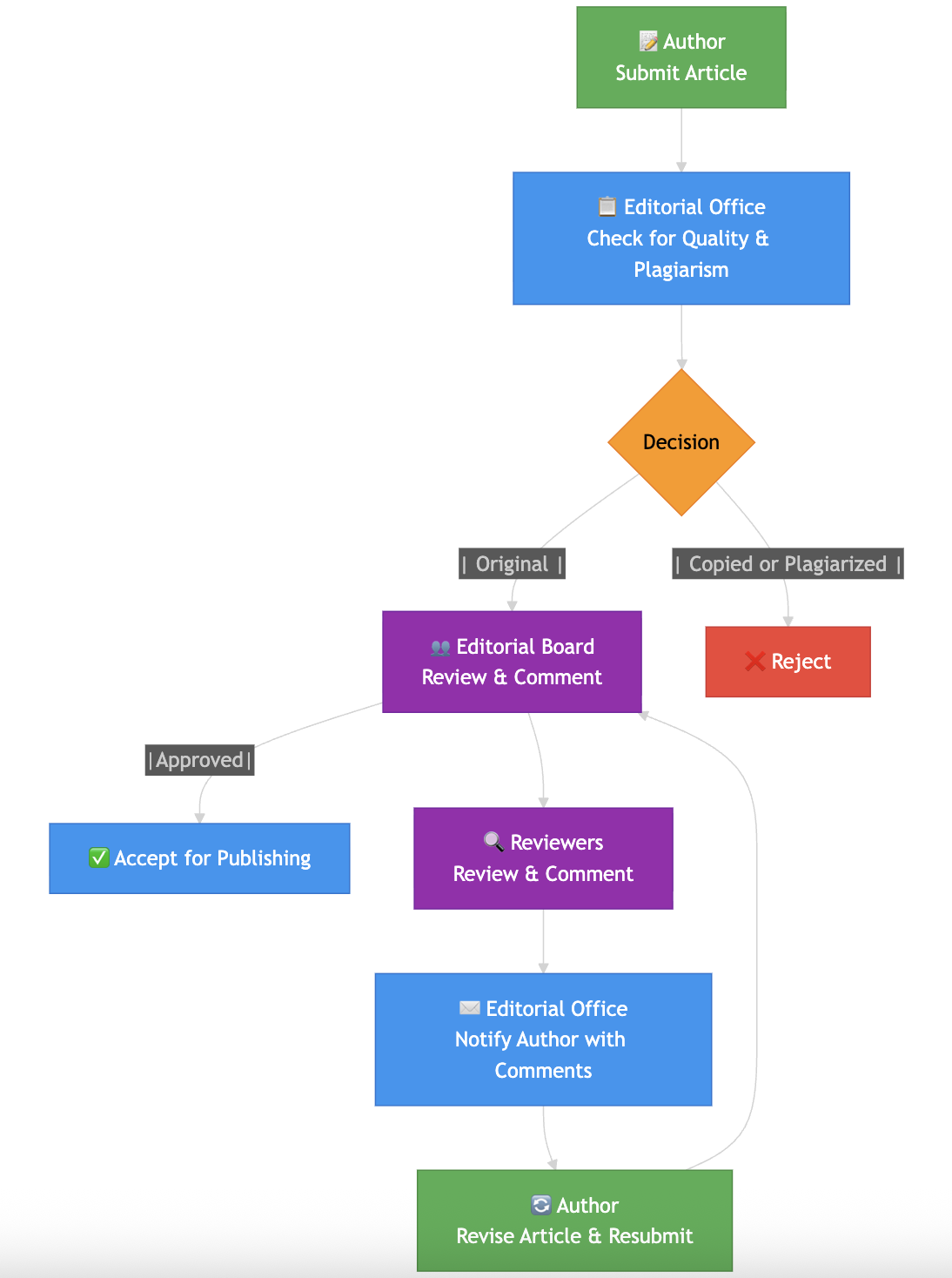
Editorial and Peer-Review Policy
Journal of Economic Intelligence and Mathematics
follows the editorial and peer-review procedures described in the
journal's policies and author guidelines. Manuscripts are assessed
for relevance to the journal's scope, originality, scientific merit,
methodological considerations, ethical compliance, and suitability
for publication.
Key features include:
-
Manuscripts are evaluated by appropriate reviewers and/or editors
with relevant subject expertise, according to the journal's
stated peer-review model.
-
The applicable peer-review model and reviewer confidentiality
arrangements are described in the journal's policies.
-
Editorial assessment considers scientific relevance, originality,
methodological quality, ethical compliance, and alignment with
the journal's scope.
-
Manuscripts undergo appropriate originality, plagiarism, and
research-integrity checks before or during the editorial process.
-
Final publication decisions are made by the responsible editor
in accordance with the journal's editorial policies and the
outcome of the applicable review process.
Publication Frequency & Format
The journal's publication frequency is
Annual (One issue per year).
Accepted articles are made available online in HTML and PDF formats
following completion of the applicable editorial and production processes,
supporting accessible and timely dissemination of published research.
Open Access Policy
Journal of Economic Intelligence and Mathematics
operates under an open-access publishing model. Published content is
freely accessible to readers without subscription or paywall
restrictions, subject to the applicable journal policies and licensing
terms.
Copyright, licensing, and reuse rights are governed by the terms
specified for the journal and individual published content.
Indexing & Archiving
The Journal of Economic Intelligence and Mathematics
seeks to make its published research discoverable through appropriate
scholarly indexing, abstracting, and discovery services. Inclusion in
any external indexing or abstracting service is subject to the
eligibility requirements, evaluation procedures, and acceptance
decisions of the respective service.
The journal is committed to maintaining accurate article metadata,
persistent identifiers, accessible article landing pages, and the
continued availability of published scholarly content.
Information about indexing, abstracting, discovery, and preservation
services is provided on a service-specific basis and is updated when
the relevant status has been established and verified.
Manuscript Submission
Authors are encouraged to submit their manuscripts through the journal's Online Submission
System (Submit Manuscript).
Manuscripts must adhere to the journal's author guidelines regarding structure, formatting,
referencing style, ethical approvals, and necessary disclosures (such as conflicts of interest
and funding).
Publication Ethics & Integrity
Journal of Economic Intelligence and Mathematics follows internationally recognized standards for publication ethics and research integrity,
which include (but are not limited to):
- Make sure you have ethical approval.
- Ensure that informed consent is obtained where required and protect the confidentiality and privacy of participants and research subjects.
- Declare any conflicts of interest.
- Be transparent about data availability.
- Clarify authorship criteria and the roles of contributors.
- Conduct anti-plagiarism checks.
- Have a clear policy for retraction and correction.













 Abstract
 HTML
HTML
 PDF
PDF