Editorial & Publication Information
60 Days
Typical Time to Final Decision
English
Publication Language
Single-Blind
Peer-Review Model
The stated decision time and acceptance rate are journal-level indicators
and may vary over time. Editorial decisions depend on manuscript quality,
scope relevance, methodological and ethical assessment, reviewer
availability, revision requirements, and author response times.
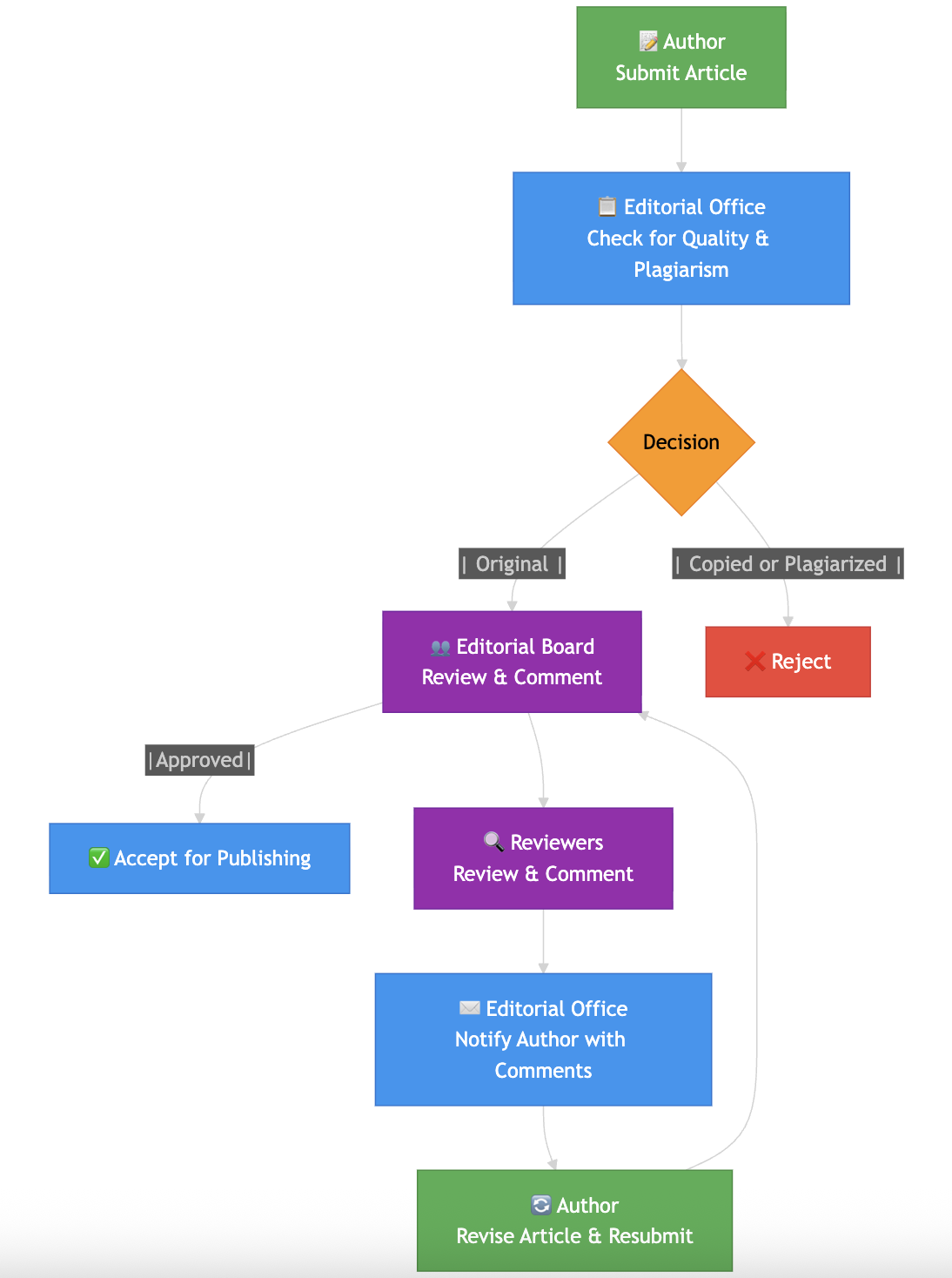
Similarity screening forms part of the journal's editorial assessment
and is not interpreted solely on the basis of a numerical similarity score.
About the Journal
Overview
The Journal of Frontier Research across Disciplines is an
international, peer-reviewed, open-access journal covering
interdisciplinary, multidisciplinary, and transdisciplinary research
across scientific, technological, engineering, health, environmental,
social, business, and humanities-related fields. The journal provides a
platform for researchers, academics, professionals, and other contributors
to communicate research findings that connect knowledge across established
disciplinary boundaries.
The journal welcomes research in areas including artificial intelligence,
machine learning, data science, computational methods, engineering,
natural and life sciences, environmental and earth sciences, health and
biomedical research, agriculture and plant sciences, business and
management, economics, social sciences, humanities, mathematics,
statistics, information science, architecture, design, and related
interdisciplinary fields.
Research addressing interactions between disciplines, emerging research
areas, hybrid methodologies, and applications of scientific or
technological approaches across different fields is also within the
journal's scope. The journal welcomes both disciplinary research with clear
interdisciplinary relevance and studies that integrate methods,
perspectives, or evidence from multiple fields.
The Journal of Frontier Research across Disciplines
publishes original research articles, review articles, short
communications, case studies, technical perspectives, methodological
contributions, and other scholarly submissions appropriate to its scope.
Manuscripts are considered in accordance with the journal's editorial
policies, ethical requirements, author guidelines, and peer-review
procedures.
The journal is committed to responsible scholarly communication,
research integrity, transparent editorial practices, accurate publication
metadata, and responsible dissemination of interdisciplinary and
cross-disciplinary research.
Aim and Scope
The Journal of Frontier Research across Disciplines
publishes original research articles, review articles, short
communications, case studies, technical perspectives, methodological
contributions, and other scholarly work addressing interdisciplinary,
multidisciplinary, and transdisciplinary research. Submissions are
welcomed across a broad range of thematic areas, including but not limited
to the following:
Natural Sciences & Life Sciences
- Biological sciences, botany, zoology, and biodiversity research
- Biotechnology, molecular biology, and bioengineering
- Chemistry, crystallography, and materials science
- Physics, including classical, modern, and applied physics
- Earth sciences, geology, and environmental systems
Engineering, Technology & Computational Sciences
- Civil, mechanical, electrical, chemical, and interdisciplinary engineering
- Computer science, artificial intelligence, and data-driven systems
- Computational modeling, simulation, and high-performance computing
- Cyber-physical systems and emerging technological infrastructures
- Applications of technology across scientific and societal domains
Environmental, Agricultural & Sustainability Studies
- Sustainable agriculture, agroecology, and food systems
- Environmental science, climate research, and ecosystem management
- Natural resource management and conservation
- Green technologies and sustainability research
- Interdisciplinary approaches to environmental resilience
Health, Medical & Biomedical Sciences
- Clinical and translational medical research
- Public health, epidemiology, and healthcare systems
- Biomedical engineering and medical technologies
- Integrative and interdisciplinary health sciences
- Data-driven and AI-assisted healthcare research
Social Sciences, Policy & Behavioral Studies
- Sociology, anthropology, and human geography
- Psychology, cognitive science, and behavioral research
- Political science, governance, and international relations
- Gender studies and social equity research
- Public policy, development studies, and societal change
Business, Economics & Management
- Economic theory, applied economics, and global markets
- Business analytics, finance, and entrepreneurship
- Organizational behavior, leadership, and strategic management
- Public relations, communication, and corporate governance
- Technology-driven business and digital economies
Humanities, Arts & Cultural Studies
- Literature, linguistics, and language studies
- History, archaeology, and cultural heritage
- Philosophy, ethics, and knowledge systems
- Creative arts, media, photography, music, and related fields
- Interactions between culture, technology, and society
Mathematics, Statistics & Interdisciplinary Methods
- Pure and applied mathematics
- Statistics, probability, and data analytics
- Mathematical modeling across disciplines
- Quantitative methods for complex systems
- Computational and applied mathematical sciences
Information, Knowledge & Library Sciences
- Information systems, knowledge management, and digital libraries
- Data curation, archival science, and information retrieval
- Scholarly communication and open science
- Interdisciplinary knowledge organization
Architecture, Design & Built Environment
- Architecture, urban planning, and smart infrastructure
- Sustainable design and environmental architecture
- Spatial analytics and geographic information systems
- Technology applications in built environments
Frontier & Multidisciplinary Research
- Interdisciplinary and transdisciplinary research integration
- Research connecting science, technology, humanities, and social sciences
- Emerging and hybrid research areas that cross traditional disciplinary boundaries
- Research addressing complex questions involving sustainability, health, digital transformation, resilience, and related societal contexts
The journal welcomes research that combines methods, theories, datasets,
technologies, or perspectives from multiple disciplines where such
integration is relevant to the research question.
Editorial and Peer-Review Policy
Journal of Frontier Research across Disciplines
follows the editorial and peer-review procedures described in the
journal's policies and author guidelines. Manuscripts are assessed
for relevance to the journal's scope, originality, scientific merit,
methodological considerations, ethical compliance, and suitability
for publication.
Key features include:
-
Manuscripts are evaluated by appropriate reviewers and/or editors
with relevant subject expertise, according to the journal's
stated peer-review model.
-
The applicable peer-review model and reviewer confidentiality
arrangements are described in the journal's policies.
-
Editorial assessment considers scientific relevance, originality,
methodological quality, ethical compliance, and alignment with
the journal's scope.
-
Manuscripts undergo appropriate originality, plagiarism, and
research-integrity checks before or during the editorial process.
-
Final publication decisions are made by the responsible editor
in accordance with the journal's editorial policies and the
outcome of the applicable review process.
Publication Frequency & Format
The journal's publication frequency is
Annual (One issue per year).
Accepted articles are made available online in HTML and PDF formats
following completion of the applicable editorial and production processes,
supporting accessible and timely dissemination of published research.
Open Access Policy
Journal of Frontier Research across Disciplines
operates under an open-access publishing model. Published content is
freely accessible to readers without subscription or paywall
restrictions, subject to the applicable journal policies and licensing
terms.
Copyright, licensing, and reuse rights are governed by the terms
specified for the journal and individual published content.
Indexing & Archiving
The Journal of Frontier Research across Disciplines
seeks to make its published research discoverable through appropriate
scholarly indexing, abstracting, and discovery services. Inclusion in
any external indexing or abstracting service is subject to the
eligibility requirements, evaluation procedures, and acceptance
decisions of the respective service.
The journal is committed to maintaining accurate article metadata,
persistent identifiers, accessible article landing pages, and the
continued availability of published scholarly content.
Information about indexing, abstracting, discovery, and preservation
services is provided on a service-specific basis and is updated when
the relevant status has been established and verified.
Manuscript Submission
Authors are encouraged to submit their manuscripts through the journal's Online Submission
System (Submit Manuscript).
Manuscripts must adhere to the journal's author guidelines regarding structure, formatting,
referencing style, ethical approvals, and necessary disclosures (such as conflicts of interest
and funding).
Publication Ethics & Integrity
Journal of Frontier Research across Disciplines follows internationally recognized standards for publication ethics and research integrity,
which include (but are not limited to):
- Make sure you have ethical approval.
- Ensure that informed consent is obtained where required and protect the confidentiality and privacy of participants and research subjects.
- Declare any conflicts of interest.
- Be transparent about data availability.
- Clarify authorship criteria and the roles of contributors.
- Conduct anti-plagiarism checks.
- Have a clear policy for retraction and correction.


















 HTML
HTML
 PDF
PDF
 Abstract