




 Download PDF

ABSTRACT
Multiplication table of a ring with identity 1 is said to have the diagonal condition if 1's occur only on the main diagonal. In this paper, we study the diagonal condition in the ring of Gaussian integers Z[i]. Furthermore, we also find the Gaussian integers α so that the rings of Gaussian integers modulo α satisfy the diagonal condition.
Keywords: diagonal condition, multiplication table, Gaussian integers, quotient ring
2020 MSC: 11R04, 11T30, 11N13.
INTRODUCTION
In [1] S.K. Chebolu (2012), he observed that 1's only appear on the main diagonal of multiplication tables of and but not for . The aim of [1] S.K. Chebolu (2012) is to find which positive integers that make 1's occur only on the main diagonal (not off diagonal) of multiplication table of . Given . Any ring which has 1's only appear on the main diagonal of its multiplication table. One says the ring satisfies diagonal condition, summarized in the following.
Theorem 1.1: Let be a positive integer for . The statements are equivalent:
- 1's occur only on the main diagonal (not off diagonal) of multiplication table of .
- If 𝑎 is an element which has multiplicative inverse in , then .
- If 𝑎 is an integer relatively prime with , then .
- If is a prime such that , then .
Finally, he found that 1's occur only on the main diagonal of multiplication table of if and only if is a divisor of 24. This became the main theorem in [2] S.K. Chebolu (2012). He also provided five distinct proofs for this theorem. However, the special property about divisors of 24 has not ended there. In 2024, J. C. Lagarias proposed problems on Floor Quotients in American Math. Monthly problem 11747, Vol. 121, p. 83. His solution appears in Vol. 123 (2016), pp. 199–200 [9].
Later, [3] Chebolu, S.K. and Mayers (2013) investigated on the (same) diagonal condition of multiplication table but in a different ring, . They had very interest result, and then formed it as a main theorem “For any positive integer , the multiplication table for the polynomial ring has 1's only on the diagonal if and only if is a divisor of 12”. Another result involved with number 12 has shown in [17] Poonen, B. and Rodriguez-Villegas, F. (2000). They discussed the number 12 related to convex lattice polygons with one interior lattice point.
Additionally, there is one paper linked to both numbers 12 and 24. In [14] Godinho, L., von Heymann, F. and Sabatini, S. (2017), they were interested in connection with mirror-symmetry and Calabi-Yau toric varieties. This kind of thing leads into aspects of Topology and Geometry.
Beyond than that [11] Genzlinger, K. and Lockridge, K. (2015) studied the diagonal condition on multiplication cube of . They gained the main theorem as “All 1's in the multiplication cube for
lie exclusively on the diagonal or the coordinate planes (where one of the three coordinates is 1) if and only if is a divisor of 4 or 6”.
Nevertheless, the author's aim is still about the diagonal condition in multiplication table of (another) classical ring: Gaussian integers , specifically a ring of Gaussian integers modulo .
GAUSSIAN INTEGERS
This section provides crucial background of Gaussian integers and Gaussian integers modulo where is nonzero in . Some materials in this section, we take it partially from [5] K. Conrad (2016), [8] D.S. Dummit and R.M. Foote (2004) and [10] J.A. Gallian (2021).
2.1 Basic knowledge of Z[i]
Gaussian integers are complex numbers is in the form where , denoted . In fact, is subring of with 1 is multiplicative identity. Since is a field, is an integral domain.
Definition 2.1.1 For , Norm of denote by .
Remark 2.1.2 It is obvious that if including the case .
Theorem 2.1.3 For .
Definition 2.1.4 The Gaussian integer is a unit if has multiplicative inverse in , i.e. there exists such that .
Theorem 2.1.5 The only Gaussian integers that are units in are .
Definition 2.1.6 For where , we say that if for some . Then is called a divisor of .
Theorem 2.1.7 For all in , if in then in .
Theorem 2.1.8 (Division Algorithm in ) Given with . There exist in such that and . In fact, we can choose that makes .
Proof. We provide proof without words in Geometry: Division Algorithm in .
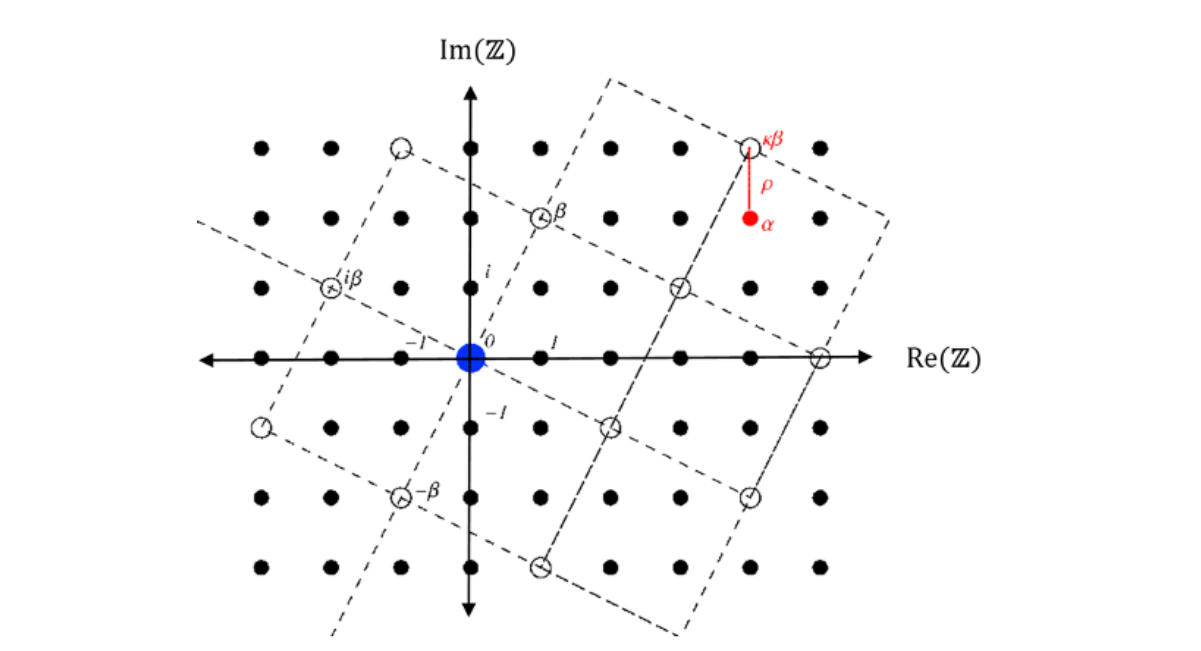
From the figure, vector from 0 to is perpendicular with vector from 0 to in Complex Plane . So the set forms squares with length netting as lattice. It is easy to see that appearing inside at least 1 square. Let be the most nearest corner point with point . Given . Then is less than or equal to half a diagonal length, i.e. .
Known fact is is a Euclidean Domain (ED). Then is also a PID and a UFD.
Definition 2.1.9 Let , we call are trivial factors of .
Definition 2.1.10 For which is not a unit, is a factorized element (reducible element). If is not a trivial factor and has only trivial factors, then is a irreducible element or called a Gaussian prime.
Theorem 2.1.11 If is a prime in , then is a Gaussian prime in .
Definition 2.1.12 A common divisor of and is a Gaussian integer such that and . Denote a greatest common divisor of and if and only if
- and ,
- For all , if and then .
One says and are relatively (Gaussian) primes if is a unit in .
Theorem 2.1.13 Given is a Gaussian prime. For all , if then or .
Remark 2.1.14 Since is a Unique Factorization Domain, Gaussian integers which are nonzero and non-unit can be factorized as multiplication of distinct Gaussian primes and a unit.
2.2 Coset representatives of quotient ring Z[i]/(α)
This subsection gives concepts of congruence–modulo and coset representatives in .
Definition 2.2.1 For Gaussian integers and , we say that congruence modulo denoted by , when .
Remark It can be proved that Congruence–Modulo is an equivalence relation on . The equivalence classes are cosets in quotient ring .
Next, we provide methods to find coset representatives of when through multiples of Gaussian in grid as followed.
- Let . Consider .
- Plot points and in the grid, then form two vectors from origin to these points.
- Extend the sided of two vectors to create a (main) square. Coset representatives of are points located inside the square and on two main vectors including origin.
- Translate the square till it can be filled the grid. Then, we have (all) cosets.
Examples 2.2.2 Find coset representatives of .
First, consider . Then follow steps 2. and 3. :
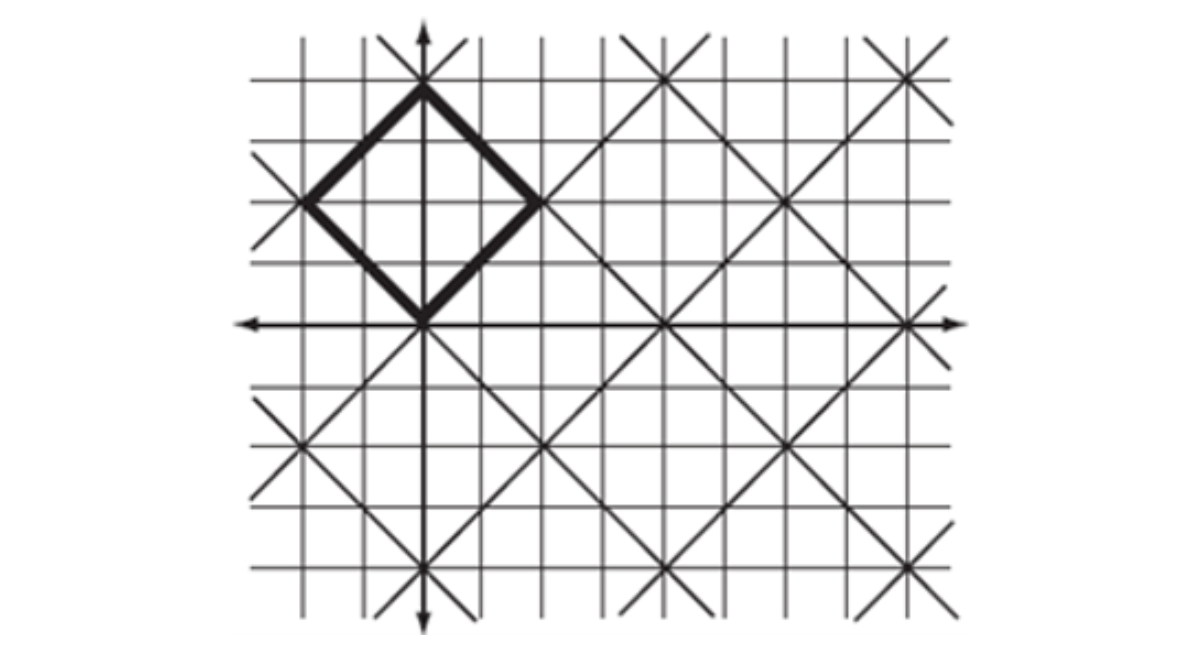
From the figure, the coset representatives of are , equivalent with points in grid.
Lemma 2.2.3 For , we have
- in if and only if in .
- if and only if and .
Let be the number of coset representatives of , i.e. .
Lemma 2.2.4 If is nonzero, then .
Lemma 2.2.5 If in , then .
Lemma 2.2.6 If and are nonzero in , then . In another word, function is multiplicative.
Theorem 2.2.7 If in , then .
Proof. By Lemma 2.2.6, . From Lemma 2.2.5, we have the right hand side of previous equation is . Since is integer and Lemma 2.2.4, it can be concluded that . Thus, . Hence, we have .
2.3 Gaussian primes
In this subsection, we find all Gaussian primes from Gaussian integers which divide primes in .
Definition In , we say that if or where is a unit in .
Lemma 2.3.1 Let be a Gaussian prime. Then, there exists a prime such that .
We can find all Gaussian primes from Gaussian integers which divide primes in .
Theorem 2.3.2 A prime in is a factorized element (reducible element) in if and only if can be written as a sum of two squares.
Remark 2.3.3 Any primes which cannot be written as a sum of two squares, then is not a factorized element (reducible element). Thus, is a Gaussian primes.
Corollary 2.3.4 If is a prime in such that , then is a Gaussian prime.
Lemma 2.3.5 Given is a prime. Either or if and only if there exist integers such that .
Theorem 2.3.6 Let be a prime in such that . Then where and whilst .
Proof. By Lemma 2.3.4, there exist integers such that . So, where and . Assume that . Then, there are 4 cases as followed
- case : we have . Then , a contradiction.
- case : we have . Then , a contradiction.
- case : we get . Then , a contradiction.
- case : we get . Then , a contradiction.
Thus, .
Theorem 2.3.7 These are all Gaussian primes:
- ,
- where are primes in s.t. ,
- and when , and are primes in s.t. .
Proof. We can find all Gaussian primes which divide prime from Lemma 2.3.1:
- When , we have . Then is satisfied the condition i.e. 1 and ,
- When is a Gaussian prime by Corollary 2.3.4,
- When , by Theorem 2.3. and are Gaussian primes where and .
Thus, we have proved.
MAIN RESULTS
From subsection 2.3 (Theorem 2.3.7), we know that all Gaussian primes are in the form
- ,
- where are primes in s.t. ,
- and when , and are primes in s.t. .
We also know that any Gaussian integer α ≠ 0 and α not a unit can be written as Gaussian primes factorization in the following theorem.
Theorem 3.1 If where is unit and are Gaussian primes such that , then
Proof. This is trivial from Chinese Remainder Theorem, see statement in [9] T. Koshy (2002).
Theorem 3.2 do not satisfy diagonal condition when .
Proof. Suppose that satisfy diagonal condition for some . Then, for all s.. where is unit, we have . In , we get that makes . Since satisfy diagonal condition for some and hence . Thus, so that . This leads a contradiction, the statement we supposed is wrong. Hence, do not satisfy diagonal condition for all .
Remark 3.3 If the order of Gaussian integers modulo α is greater than or equal to 3, then multiplication table of Z[i]/(α) do not have diagonal condition.
Lemma 3.4 do not satisfy diagonal condition when are primes in s.t. .
Proof. Since are primes in such that are Gaussian primes. Then is a finite field which has order because is the maximal ideal. Thus, is a cyclic group with its order is equal to . By Remark 3.3, the statement of lemma is proved.
Theorem 3.5 do not satisfy diagonal condition when and are primes in such that .
Proof. Assume that satisfy diagonal condition for some . Then, we have s.. where is unit, ). However, there exists such that the order of modulo is . That makes , contradicts with by assumption. Hence, the statement of theorem is confirmed.
Lemma 3.6 and do not satisfy diagonal condition when and are primes in such that .
Proof. By Theorem 2.3.7, without loss of generality. Since is a Gaussian prime, is a field because is a maximal ideal. Thus, is a cyclic group with order . Then, there exists such that the order of modulo is equal to so that . Hence, does not satisfy diagonal condition.
Theorem 3.7 and do not satisfy diagonal condition when and where are primes in such that .
Proof. By Theorem 2.3.7, without loss of generality. Suppose satisfy diagonal condition. Then, for all . In , there exists such that the order of modulo is so that . By the assumption, we need to have , a contradiction. Thus, the statement of theorem is proved.
From Theorem 3.1 to Theorem 3.7 including remark and lemmas, we can generate the main theorem as followed:
Theorem 3.8 Multiplication table of have diagonal condition if and only if or .
OPEN PROBLEMS AND INTERESTING POINTS
The author suggests readers to investigate diagonal condition on several interesting rings e.g. , Real/ Imaginary Quadratic fields ( where is square-free, Real when ; Imaginary when or any other imaginary quadratic fields have units only 1 and . Also, all related open problems such as Floor Quotient for the previous-mentioned domains with a variant problem analogs with what the author did in this paper.
DISCLOSURES
The author declares that there are no conflicts of interest that could have influenced the objectivity of this research or the writing of this paper.
ACKNOWLEDGEMENTS
The author would like to thank her BS advisor Assoc. Prof. Dr. Ajchara Harnchoowong for inspiration on research of Number Theory. Additionally, the author would like to praise productive comments from Prof. Jeffrey Clark Lagarias while attending the 2026 Gainesville international Number Theory conference at University of Florida, USA. The most important part to mention is her family, they always cheer her up in any stage of this research work.
REFERENCES
- Burns G, Alper AM, Nowick AS. Introduction to group theory with applications. New York: Academic Press; 1977 Jan 1. [Google Scholar]
- Chebolu SK. What is special about the divisors of 24?. Mathematics Magazine. 2012 Dec 1;85(5):366-72. [Google Scholar]
- Chebolu SK, Mayers M. What is special about the divisors of 12?. Mathematics Magazine. 2013 Apr 1;86(2):143-6. [Google Scholar]
- Cohen S. A study of Gaussian integers. [Google Scholar]
- Kodsueb C. Diagonal Condition in Multiplication Table of $\displaystyle {\,\mathbb {Z}[i]/(\alpha)} $. arXiv preprint arXiv:2606.02975. 2026 Jun 2. [Google Scholar]
- Davenport H. Multiplicative number theory. Springer Science & Business Media; 2013 Jun 29. [Google Scholar]
- Dresden G, Dymàček WM. Finding factors of factor rings over the Gaussian integers. The American Mathematical Monthly. 2005 Aug 1;112(7):602-11. [Google Scholar]
- Gallian J. Contemporary abstract algebra. Chapman and Hall/CRC; 2021 Jan 19. [Google Scholar]
- Genzlinger K, Lockridge K. Sophie Germain primes and involutions of ℤn×. Involve, a Journal of Mathematics. 2015 Jun 23;8(4):653-63. [Google Scholar]
- Gerjets MS. The distribution of primitive roots in fields of order p². [Google Scholar]
- Ginzburg A. Representation of groups by generalized normal multiplication tables. Canadian Journal of Mathematics. 1967 Jan;19:774-91. [Google Scholar]
- Godinho L, von Heymann F, Sabatini S. 12, 24 and beyond. Advances in Mathematics. 2017 Oct 15;319:472-521. [Google Scholar]
- Koshy T. Elementary number theory with applications. Academic press; 2002. [Google Scholar]
- Lagarias JC, Richman DH. The family of a-floor quotient partial orders. InCombinatorial and Additive Number Theory, New York Number Theory Seminar 2022 May 24 (pp. 283-318). Cham: Springer Nature Switzerland. [Google Scholar]
- Poonen B, Rodriguez-Villegas F. Lattice polygons and the number 12. The American Mathematical Monthly. 2000 Mar 1;107(3):238-50. [Google Scholar]
- Sabuncu C, Táfula C. The multiplication table problem in large dimensions. arXiv preprint arXiv:2608.16163. 2026 Aug 17. [Google Scholar]
- Schlitt J. Multiplication Tables for Integers with Restricted Prime Factors. arXiv preprint arXiv:2603.19212. 2026 Mar 19. [Google Scholar]
- Wahab MA. Elements of Group Theory and Multiplication Tables. InSymmetry Representations of Molecular Vibrations 2022 Sep 21 (pp. 49-122). Singapore: Springer Nature Singapore. [Google Scholar]