




 Download PDF
ABSTRACT
A proposed doctoral research project tentatively entitled “From Availability to Impact: A Realist Evaluation of How Digital Dementia Risk-Reduction Education Influences Engagement, Interpretation, and Behaviour in Unimpaired Midlife Adults” is underpinned by a programme of original conceptual scholarship, developed by the research candidate through a programme of five conceptual papers. Collectively, these publications examine dementia prevention literacy, dementia education, the evaluation of digital dementia education interventions, and the integration of complementary theoretical frameworks. Together, they establish the conceptual, theoretical, and methodological foundations of the proposed study.
This body of work identified a consistent gap between the availability of dementia risk-reduction information and meaningful behavioural change, highlighting the importance of engagement, interpretation, behavioural readiness, and contextual influences in shaping outcomes. The proposed PhD builds directly on these publications by moving from conceptual development and framework integration to empirical investigation through a realist-informed evaluation of digital dementia risk-reduction education. The following sections describe the research programme, its contribution to the development of the integrated conceptual framework, and its progression to the proposed doctoral study.
Keywords : Dementia Prevention; Dementia Prevention Literacy; Digital Dementia Education; Health Literacy; Behaviour Change; Interpretative Engagement; Realist Evaluation; Knowledge Translation
INTRODUCTION
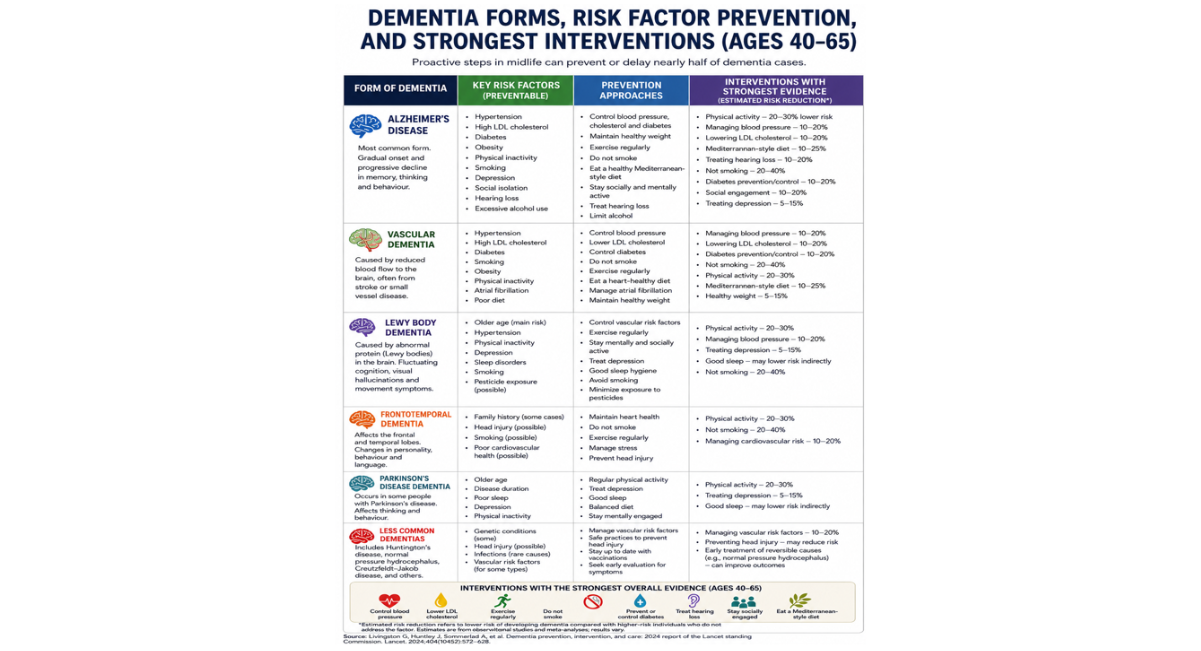
Dementia represents one of the most significant public health challenges of the twenty-first century. Currently, more than 55 million people globally are living with the condition, a figure projected to scale dramatically over coming decades due to rapid population ageing (World Health Organisation, 2025). Although age remains the strongest non-modifiable risk factor, dementia is increasingly understood as a condition in which proactive prevention and delay may be possible. The 2024 Lancet Commission on Dementia Prevention, Intervention and Care identified fourteen modifiable life-course risk factors accounting for approximately 45% of dementia cases worldwide [1]. These findings firmly reinforce risk reduction as a critical global health priority (Appendix 1).
Despite this growing epidemiological evidence base, public understanding of dementia risk reduction remains limited and inconsistent. Global systematic data reveals widespread variations in how communities perceive modifiable versus non-modifiable risks, with many individuals continuing to view cognitive decline as an unavoidable consequence of growing old [2]. Consequently, general awareness of modifiable risk factors does not consistently translate into meaningful behavioural change [3]. This gap highlights a fundamental issue in traditional health education: the raw availability of information does not guarantee engagement, interpretation, or behavioural action. Instead, individuals actively construct personal meaning from health information in ways that are deeply shaped by cognitive, social, and environmental factors.
Digital health technologies have significantly expanded opportunities for public health outreach, offering a highly scalable infrastructure to help bridge current prevention gaps for midlife and older adults [4,5]. However, systematic evidence indicates that digital improvements in raw knowledge do not necessarily produce downstream behavioural change, and translation outcomes continue to vary widely across distinct user types and contexts [6,7].
These limitations reflect broader developments in health literacy theory. Nutbeam’s model emphasises that individuals do not passively receive health information but must actively interpret and apply it within their unique lived experience [8]. Similarly, behaviour change theory, particularly the COM-B model, conceptualises behaviour as an interactive product of capability, opportunity, and motivation rather than knowledge exposure alone [9].
Implementation science further demonstrates that educational intervention outcomes are highly context-dependent , while realist evaluation provides a robust explanatory framework for evaluating this real-world variability through Context–Mechanism–Outcome (CMO) configurations [10,11]. Within this theoretical convergence, a key gap remains in explaining how individuals transform digital dementia education into psychological behavioural readiness. This article addresses that gap through a structured programme of conceptual scholarship culminating in an integrated, realist-informed framework (Figure 1).
Background Narrative: The Knowledge-to-Action Gap
Over recent years, a central question has shaped this programme of research: why does greater awareness of dementia risk factors so rarely translate into meaningful behavioural change?
Despite strong epidemiological evidence that many dementia risk factors are modifiable, public understanding remains inconsistent, and uptake of preventive behaviours is limited. While dementia prevention information is increasingly available through public health campaigns and digital platforms, access alone does not appear sufficient to influence behaviour. This observation has guided the comprehensive programme of conceptual scholarship evaluated below, establishing an analytical pipeline moving from information availability to real-world behavioural impact.
Materials and Methods (Conceptual Synthesis Strategy)
As a comprehensive theoretical review paper, the "materials" comprise a cumulative, five-stage programme of original conceptual scholarship and framework integration (see Appendix 2). The methodology relies on an integrated synthesis of literature spanning health literacy, behavioural psychology, and implementation science.
Rather than treating these domains as isolated contributions, they are analysed as cumulative stages in the development of an integrated explanatory framework. Table 1 maps this progression, demonstrating how each stage contributed to increasing theoretical refinement. Across this programme, a consistent finding emerged: outcomes are shaped not only by exposure to information but by how individuals engage with, interpret, and apply that information within their personal and social contexts.
|
Stage / Strand |
Core Focus & Literature Derived |
Key Theoretical Synthesis & Contribution |
|
1. Dementia Prevention Literacy Framework |
Epistemic gaps in public understanding of modifiable risk factors; evidence-to-action barriers. |
Rejects linear information-deficit models; introduces interpretative mental models, loops, and environmental influences (Carey, 2026c). |
|
2. Reconceptualising Dementia Education |
Critical evaluation of traditional health education; shift from information transfer to meaning-making. |
Integrates health literacy with COM-B and implementation science; establishes "interpretative engagement" as a core emotional/cognitive mechanism (Carey, 2026b). |
|
3. Realist Framework for Digital Education |
System-level modeling of digital education delivery and real-world complexity. |
Conceptualises digital platforms as multi-component ecosystems organized through an explicit Context-Mechanism-Outcome (CMO) logic (Carey, 2026a). |
|
4. Integrated Theoretical Synthesis |
Comparative conceptual analysis and cross-framework reconciliation. |
Unifies public health literacy landscapes with explicit evaluator pipelines, embedding behavioural appraisal directly into CMO architectures (Carey, 2026d). |
|
5. Synthesis & Operational Design |
Structural alignment of qualitative sense-making with quantitative platform analytics. |
Defines the methodological blueprint to empirically track and test how digital interfaces trigger internal user mechanisms across diverse midlife demographics. |
|
6. Doctoral Operationalisation |
Real-world empirical application and validation of the synthesised architecture. |
Translates the five conceptual strands into an active, mixed-methods PhD study to evaluate engagement, interpretation, and behavioural readiness in midlife adults (40–65 years). |
Table 1: Conceptual Evolution and Framework Strand Integration
The Integrated Conceptual Framework Architecture
The integrated conceptual framework presented in Figure 1 emerged directly from this synthesis. The synthesis of these five strands culminated in the development of the Realist-Informed Conceptual Framework for Evaluating Digital Dementia Education (presented in Figure 1), bypassing standard linear evaluation structures and positioning digital health education as a complex adaptive intervention whose success depends entirely on context-sensitive mechanism activation. The architecture breaks down the digital public health ecosystem into four core operational dimensions:
- Wider Context & Access Conditions (C): Individual baselines (digital health literacy, cultural backgrounds) and structural boundaries (socioeconomic status, geographic location) that shape how a user approaches a digital resource (Components 1 and 2 of Figure 1).
- The Resource vs. User Engagement (C/O): The simple conversion of Resource Availability into superficial User Engagement (metrics such as logins, attention duration, and click frequencies) as outlined in Component 2 of Figure 1.
- Generative Mechanisms (M): The vital transition from passive user interaction to Interpretative Engagement (Component 3 of Figure 1). This represents the internal cognitive and emotional "sense-making" loop where an individual processes personal relevance and constructs risk perceptions, directly generating Behavioural Readiness (Component 4 of Figure 1: advancements in self-efficacy and an explicit intention to act).
- Real-World Outcomes (O): The final translation of psychological readiness into sustained, real-world risk-reduction behaviours (Components 5 and 6 of Figure 1), mediated or moderated by immediate contextual factors like social circles and environmental demands.
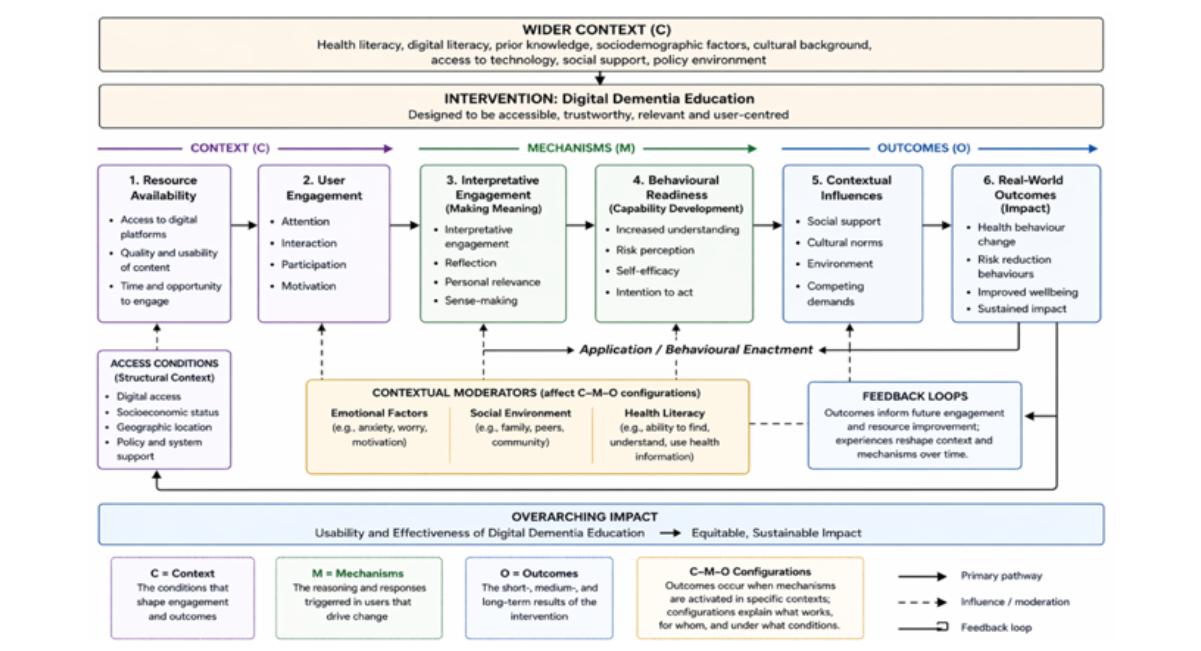
Figure 1: Realist-Informed Conceptual Framework for Evaluating Digital Dementia Education
Integrative Explanation of the Research Programme and the Conceptual Foundations
This doctoral research is grounded in a coherent programme of prior conceptual and theoretical work that collectively informs its design, focus, and methodological orientation. Across a series of interrelated publications, the research candidate has developed an integrated body of scholarship examining how dementia-related knowledge is translated into public understanding, how educational interventions are interpreted and engaged with, and why improvements in knowledge do not consistently translate into behavioural change.
To visually map this intellectual progression, the image entitled From Information to Impact illustrates the systematic timeline of the research journey tracing how the initial foundational frameworks iteratively built upon one another to culminate in the proposed realist PhD study.
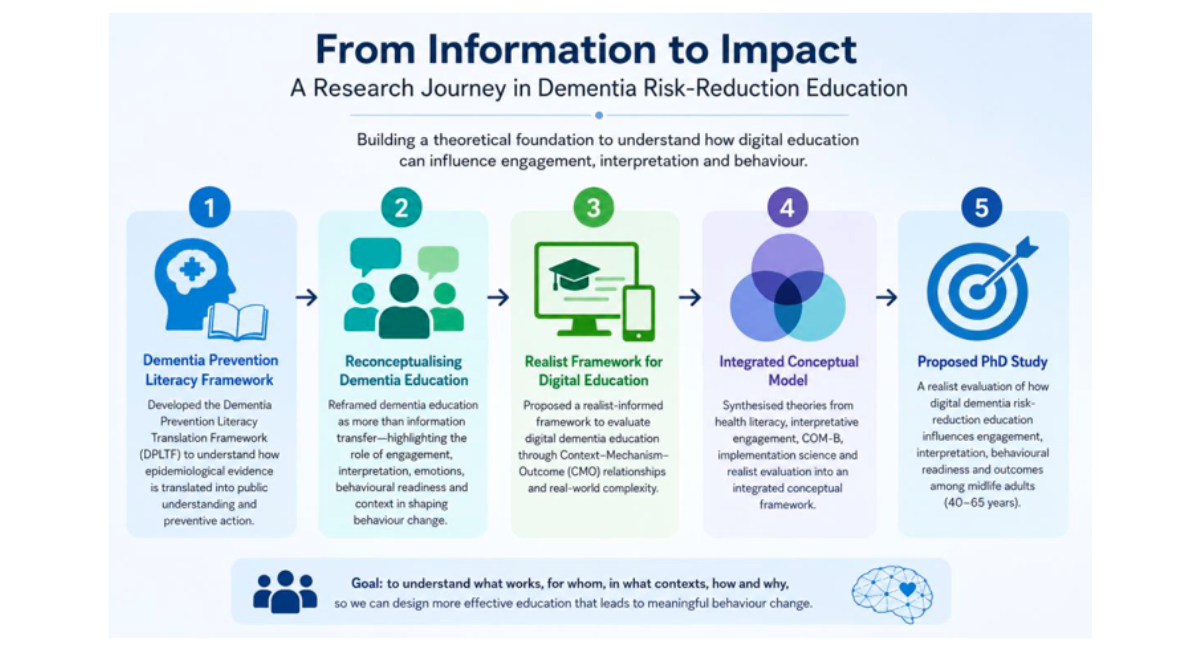
Conceptual Development Across the Five Papers
The persistent gap between dementia prevention knowledge and behavioural change suggests that existing models of health education are insufficient. While information provision is necessary, it is not sufficient to explain behavioural outcomes. This observation forms the basis for reconceptualising dementia education as a process of engagement and interpretation rather than transmission. This evolutionary process spans five core papers mapped across the progressive stages of the research journey illustrated in the image.
Stage 1: Dementia Prevention Literacy Framework – Established by Paper 1, which introduced the concept of dementia prevention literacy and identified variability in public understanding of modifiable risk factors (Carey, 2026c).
Stage 2: Reconceptualising Dementia Education – Driven by Paper 2, which reframed dementia education as interpretative engagement, shifting emphasis from linear information delivery to active meaning-making processes [12].
Stage 3: Realist Framework for Digital Education – Comprising Paper 3 (which integrated health literacy theory and behavior change models like COM-B to explain multidimensional behavioural readiness) and Paper 4 (which introduced realist evaluation logic, focusing on Context–Mechanism–Outcome configurations to explain real-world complexity) Comprising Paper 3 [13] and its operational methodologies under peer review [14].
Stage 4: Integrated Conceptual Model – Synthesised in Paper 5, which unified these distinct theoretical strands into a single integrated explanatory framework where interpretative engagement acts as the central generative mechanism linking digital resources to impact.
Stage 5: Proposed PhD Study – The operational culmination of all five papers, translating the entire conceptual architecture into an empirical, mixed-methods realist evaluation among midlife adults.
Empirical Operationalisation of the Realist Engine
To ground this theoretical synthesis empirically, the mixed-methods realist design will explicitly evaluate how quantitative data and qualitative insights interact to map Context-Mechanism-Outcome (CMO) configurations:
- Quantitative Strands: System-level user analytics, platform interaction frequencies (Box 2: User Engagement), and validated digital health literacy scales will be utilized to baseline individual user characteristics (Wider Context) and map structural access boundaries (Access Conditions).
- Qualitative Strands: Longitudinal semi-structured interviews and cognitive mapping protocols will uncover the underlying reasoning, psychological responses, and meaning-making processes triggered within users (Box 3: Interpretative Engagement and Box 4: Behavioural Readiness).
Data Analysis and Synthesis Plan (RAMESES II Compliant)
To systematically evaluate how digital dementia risk-reduction education influences user trajectories, data analysis will follow a realist synthesis approach adhering strictly to the RAMESES II reporting standards (Wong et al., 2017). Rather than analysing quantitative and qualitative datasets in isolation, an iterative, retroductive analysis strategy will be employed to identify, test, and refine Context-Mechanism-Outcome (CMO) configurations. The analysis is structured around operationalising the core realist generative equation:
C+M=O
The systemic mapping, data pathways, and convergence points of this mixed-methods architecture are visually structured in Figure 2, which serves as the operational roadmap for the analytical stages detailed below.
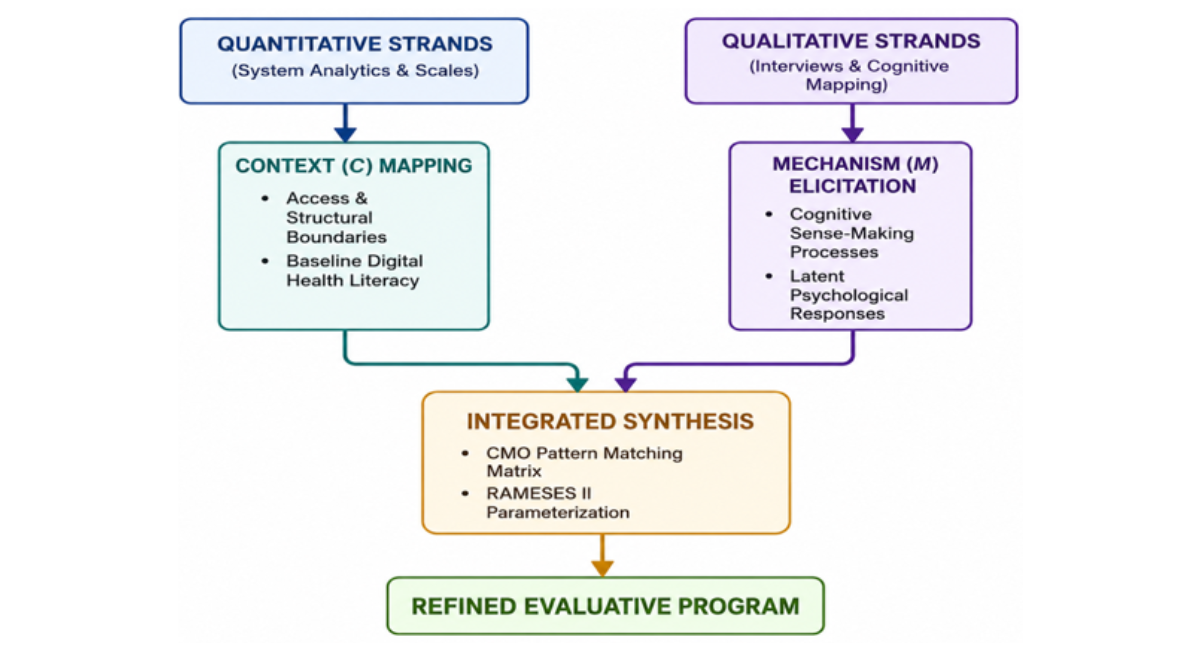
Figure 2: Mixed-Methods Realist Data Analysis Workflow
Quantitative Data Analysis (Context and Structural Outcomes)
Quantitative strands will focus primarily on mapping the structural boundaries of the Wider Context (C) and auditing User Engagement (O/C).
- Descriptive & Inferential Statistics: System-level user analytics and platform interaction frequencies (e.g., attention, participation) will be cross-tabulated against socio-demographic factors and validated digital health literacy scales using descriptive and inferential statistics.
- Access Boundary Profiling: This analysis will define the baseline structural access boundaries and demographic contexts (C) that shape how varying users access the digital resource.
- Proximal Outcomes: Longitudinal changes in health literacy scores, risk perception, and self-efficacy will be analysed using paired t-tests or repeated-measures ANOVA to quantify proximal behavioural readiness outcomes (O).
Qualitative Data Analysis (Mechanism Elicitation)
Qualitative data from longitudinal semi-structured interviews and cognitive mapping protocols will be analysed using a realist-informed thematic analysis approach.
- Retrospective Coding: Transcripts will be coded using an initial deductive framework derived from the integrated conceptual model (e.g., Interpretative Engagement, Resource Availability, and Behavioral Readiness).
- Inductive Logic Application: This framework will remain open to inductive coding to capture unexpected reasoning patterns.
- Eliciting Latent Mechanisms: The analysis will specifically focus on extracting the latent reasoning, psychological responses, and meaning-making processes (M) triggered within specific types of users when they interact with the educational material.
Mixed-Methods Realist Integration and Synthesis (CMO Pattern Synthesis)
The final analytical phase involves the configuration and synthesis of both strands using CMO pattern-matching. Quantitative data identifying what works and for whom will be systematically matrix-mapped against qualitative themes explaining how and why.
The analysis will progress through iterative rounds of testing configurations to determine under what specific socio-demographic and structural circumstances ( ) a digital resource ( ) triggers an internal interpretative or emotional mechanism ( ), thereby producing or inhibiting specific behavioral enactment outcomes ( ). Per the RAMESES II standards, contradictory findings or instances where the intervention failed to trigger the expected behavioural loops will be treated as critical analytical pivot points to refine the boundaries of the final, transferable explanatory framework.
By investigating how specific structural and wider circumstances ( ) trigger underlying cognitive or psychological reasoning ( ) to produce varied behavioral changes ( ), the study operationalises the classic realist proposition that . This operational approach bypasses standard linear evaluation models to explain exactly what elements of digital platforms work, for whom, and under what specific socio-demographic circumstances. The empirical phase of this research is designed and will be monitored in strict accordance with the RAMESES II reporting standards for realist evaluations to ensure methodological transparency and validity.
The integrated conceptual framework presented in Figure 1 (Appendix 3) emerged directly from this synthesis.
Publication-to-PhD Research Trajectory
The systematic evolution of this research programme follows a direct trajectory from initial macro-level literacy concepts to an integrated, empirically testable evaluation design:
[ Stage 1: Foundational Literacy Framework]
Dementia Prevention Literacy Translation Framework (DPLTF)
│
▼
[ Stage 2: Process & Reconceptualisation]
Reconceptualisation of Dementia Education (Meaning-Making Mechanisms)
│
▼
[ Stage 3: Methodological Integration]
Realist Evaluation Framework (Introduction of CMO Architecture)
│
▼
[ Stage 4: Theoretical Synthesis]
Integrated Analytical Perspective (Unifying DPLTF & Realist Logic)
│
▼
[ Stage 5: Conceptual Architecture]
Integrated Conceptual Framework (Synthesised Theoretical Framework)
│
▼
[ Stage 6: Doctoral Operationalisation]
Proposed PhD Study (Empirical Realist Mixed-Methods Evaluation)
Digital Knowledge Translation Architecture and Public Stakeholder Mobilisation
The proposed research recognises that generating evidence alone is insufficient to influence dementia risk reduction and behaviour change. Effective translation of research findings into policy, practice, and community action is essential to maximise public health impact. Accordingly, a comprehensive dissemination strategy will be implemented throughout the candidature.
Research findings will be disseminated through peer-reviewed journal publications, conference presentations, professional networks, and stakeholder engagement activities involving health professionals, policymakers, dementia advocacy organisations, and community groups. The research will also utilise digital communication platforms, including professional websites, webinars, and social media channels, to increase awareness and accessibility of evidence-based information relating to dementia risk modification and behaviour change.
Rather than working as linear, unidirectional broadcasting tools, the selected digital translation channels (see Table 2) are conceptualized as infrastructure for bidirectional engagement. Public commentary, digital dialogue, and community feedback on these platforms will actively serve to validate, refine, and stress-test emerging CMO theories with midlife audiences in real time. These activities will complement, rather than replace, traditional academic dissemination pathways.
Social Media Dissemination Platforms and Knowledge Translation Channels
Digital communication platforms, including professional networking and social media channels, will support broader dissemination and public engagement activities alongside traditional academic dissemination pathways. The dissemination strategy aims to ensure that research outcomes contribute not only to academic knowledge but also to practical interventions, public awareness, and policy development that support healthy ageing and dementia prevention.
|
Platform |
Primary Target Audience |
Purpose |
Resource Link |
|
|
Project Portfolio / Institutional Stakeholders |
Disseminating peer-reviewed findings, framework syntheses, and driving policy-level stakeholder engagement. |
Link |
|
X (Twitter) |
Researchers, Public Health Practitioners & Media |
Facilitating real-time public health dissemination, academic dialogue, and participating in global dementia prevention networks. |
Link |
|
|
Professional Networks & Academic Stakeholders |
Sharing accessible digital public health summaries and encouraging professional networking dementia literacy discussions. |
Link |
|
Research Repository |
Academic Peers & Postgraduate Researchers |
Hosting preprints, datasets, and open-access materials regarding the integrated framework and CMO configurations. |
Link |
|
ORCID / Digital Profile |
Global Research Institutions & Faculty Panels |
Tracking academic credentials, publication trajectories, and cross-institutional project contributions over the PhD course. |
Link |
|
|
Community Outreach & Midlife Public Engagement |
Sharing accessible digital public health summaries, infographics, and encouraging community-level dementia literacy discussions. |
Link |
Table 2: Digital Knowledge Translation (KT) Architecture and Stakeholder Mobilisation Channels
DISCUSSION
This programme contributes to a growing body of literature challenging linear assumptions in health education. The findings suggest that digital dementia risk-reduction education does not operate as a direct driver of behaviour but as a contextual trigger for interpretative processes. Interpretative engagement emerges as the central mechanism through which individuals construct meaning from dementia prevention information. This extends health literacy theory by embedding it within a realist explanatory structure.
The integration of COM-B theory further clarifies how interpretative engagement interacts with capability, opportunity, and motivation to shape behavioural readiness. Rather than acting as independent determinants, these constructs are activated through interpretative processes. From an implementation science perspective, variability in outcomes is not evidence of intervention failure but of context-sensitive mechanism activation (Nilsen, 2015). This positions digital dementia education as a complex adaptive intervention rather than a linear educational tool.
CONCLUSION
This article presents a structured programme of conceptual scholarship that integrates dementia prevention literacy, health literacy, behaviour change theory, implementation science, and realist evaluation into a unified explanatory framework. The programme identifies interpretative engagement as the central mechanism linking digital dementia risk-reduction education to behavioural outcomes. It demonstrates that behavioural change emerges not from information exposure alone but from context-dependent interpretative processes. This complete framework establishes the necessary theoretical and methodological foundations to guide future empirical, mixed-methods realist evaluations of digital health education resources.
Looking Ahead
Scholarly discussions are welcome with researchers, clinicians, educators, public health practitioners, and others interested in dementia prevention, health literacy, behaviour change, digital health, and realist evaluation. Exploring opportunities for ongoing collaboration and scholarly discussion helps ensure the continuous refinement of interactive educational systems.
DECLARATIONS
CONFLICT OF INTEREST
None declared.
AUTHOR CONTRIBUTIONS
Sole author conceptualisation and manuscript development.
FUNDING STATEMENT
No external funding was received.
DATA AVAILABILITY STATEMENT
No datasets were generated or analysed during this conceptual review.
ETHICAL APPROVAL / INFORMED CONSENT
Not required for this conceptual scholarship and theoretical framework study.
ACKNOWLEDGMENTS
Not applicable.
Appendix 1: Program Visual Graphic Asset
The poster was informed by the findings of Livingston G, Huntley J, Sommerlad A, et al. Dementia prevention, intervention, and care: 2024 report of the Lancet Standing Commission. The Lancet. 2024;404(10452):572–628.
While evidence suggests that up to 45% of dementia cases may be preventable or delayed through modification of known risk factors, awareness of these risks does not consistently lead to engagement with risk-reducing behaviours. This observation underpins my proposed PhD research, which examines how midlife adults engage with, interpret, and apply digital risk-reduction education in real-world settings.
Appendix 2: Publications and Scholarly Outputs Supporting the Proposed PhD
The publications arising from this programme of research collectively informed the development of the integrated conceptual framework presented in Figure 1 (Appendix 3) and provide the conceptual, methodological, and theoretical foundations for the proposed doctoral study. These publications comprise five peer-reviewed publications, and associated preprints and a research repository.
Peer-Reviewed Publications
Carey, P. (2026a). Beyond Information Delivery: Towards a Realist-Informed Conceptual Framework for the Evaluation of Digital Dementia Education. Journal of Preventive Medicine & Healthcare, 8(2), 1048. https://doi.org/10.47739/preventivemedicine.1048
Carey, P. (2026b). Reconceptualising Dementia Education: From Information Transfer to Behavioural and Contextual Change. International Internal Medicine Journal (IIMJ): OA, 4(2), 01-09. https://www.opastpublishers.com/journal/international-internal-medicine-journal/articles-in-press
Carey, P. (2026). A Conceptual Framework for Understanding Dementia Prevention Literacy: Bridging the Translation Gap Between Epidemiological Evidence and Public Action. Epidemiology and Public Health, OA, 2(1), 01-12. https://doi.org/10.65157/EPHOC.2026.008
Carey, P. (2026d). From Dementia Prevention Literacy to Realist-Informed Digital Dementia Education: An Integrated Theoretical Perspective, International Journal of Natural Sciences and Interdisciplinary Research: OA, 1(2), 01-07. https://l1nq.com/drw2y3v The DOI
Carey, P. (2026f). Understanding How Digital Dementia Risk-Reduction Education Works: A Realist-Informed Mixed-Methods Study of Engagement, Interpretation and Behavioural Readiness in Midlife Adults. Biomedical Science and Clinical Research: OA,5(2). DOI
Manuscript submitted; under peer review
Carey, P. (2026g). From Information to Impact: Building a Research Programme in Dementia Risk-Reduction Education, HealthGuard: Health and Preventive Medicine Research Journal: OA.
Preprints
Carey, P. (2026a). Beyond Information Delivery: Towards a Realist-Informed Conceptual Framework for the Evaluation of Digital Dementia Education. Preprints. https://doi.org/10.20944/preprints202605.1316.v2
Carey, P. (2026b). Reconceptualising Dementia Education: From Information Transfer to Behavioural and Contextual Change. Preprints. https://doi.org/10.20944/preprints202605.1879.v1
Carey, P. (2026c). A Conceptual Framework for Understanding Dementia Prevention Literacy: Bridging the Translation Gap Between Epidemiological Evidence and Public Action. Preprints. https://doi.org/10.20944/preprints202606.0612.v1
Carey, P. (2026e). Understanding How Digital Dementia Risk-Reduction Education Works: A Realist-Informed Mixed-Methods Study of Engagement, Interpretation and Behavioural Readiness in Midlife Adults. Preprints.
Research Repositories
Carey, P. (2026d, June). From Dementia Prevention Literacy to Realist-Informed Digital Dementia Education: An Integrated Theoretical Perspective. figshare. Journal contribution. https://doi.org/10.6084/m9.figshare.32691471.v1
Carey, P. (2026e). A Programme of Conceptual Scholarship Underpinning the Development of a Realist Evaluation of Digital Dementia Risk-Reduction Education. figshare. Preprint. https://doi.org/10.6084/m9.figshare.32746245.v1
Carey, Peter (2026g). Dementia Forms, Risk Reduction Factors and Strongest Interventions Ages 40-65. figshare. Poster. https://doi.org/10.6084/m9.figshare.32781693.v1
Carey, Peter (2026h). From Information to Impact: Building a Research Programme in Dementia Risk-Reduction Education. figshare. Poster. https://doi.org/10.6084/m9.figshare.32786724.v2
REFERENCES
- Carey P. Beyond information delivery: Towards a realist-informed conceptual framework for the evaluation of digital dementia education. [Google Scholar]
- Carey P. Reconceptualising Dementia Education: From Information Transfer to Behavioural and Contextual Change. [Google Scholar]
- Carey P. A conceptual framework for understanding dementia prevention literacy: Bridging the translation gap between epidemiological evidence and public action.[Google Scholar]
- Daniels K, Bonnechère B. Harnessing digital health interventions to bridge the gap in prevention for older adults. Frontiers in public health. 2024 Jan 8;11:1281923. [Crossref] [Google Scholar] [Pub Med]
- Livingston G, Huntley J, Liu KY, Costafreda SG, Selbæk G, Alladi S,et.al. Dementia prevention, intervention, and care: 2024 report of the Lancet standing Commission. The lancet. 2024 Aug 10;404(10452):572-628. [Crossref] [Google Scholar] [Pub Med]
- Michie S, Van Stralen MM, West R. The behaviour change wheel: a new method for characterising and designing behaviour change interventions. Implementation science. 2011 Apr 23;6(1):42. [Crossref] [Google Scholar] [Pub Med]
- Murray E, Hekler EB, Andersson G, Collins LM, Doherty A, Hollis C,et.al. Evaluating digital health interventions: key questions and approaches. American journal of preventive medicine. 2016 Nov 1;51(5):843-51. [Crossref] [Google Scholar] [Pub Med]
- Nilsen P. Making sense of implementation theories, models, and frameworks. In Implementation Science 3.0 2020 Mar 19 (pp. 53-79). Cham: Springer International Publishing. [Crossref] [Google Scholar] [Pub Med]
- Nutbeam D, Lloyd JE. Understanding and responding to health literacy as a social determinant of health. Annual review of public health. 2021 Apr 1;42(1):159-73. [Crossref] [Google Scholar] [Pub Med]
- Pawson R, Tilley N. Realist evaluation [Internet]. 2004 Feb 27.[Google Scholar]
- Sambou ML, Dobbe JH, Albers EA, Deckers K, Arends LR, Ikram MA,et.al. Knowledge and perception of dementia risk and protective factors: a systematic review and meta-analysis. The Journal of Prevention of Alzheimer's Disease. 2026 Jun 1;13(6):100565. [Crossref] [Google Scholar] [Pub Med]
- Webb T, Joseph J, Yardley L, Michie S. Using the internet to promote health behavior change: a systematic review and meta-analysis of the impact of theoretical basis, use of behavior change techniques, and mode of delivery on efficacy. Journal of medical Internet research. 2010 Feb 17;12(1):e1376. [Crossref] [Google Scholar] [Pub Med]
- Wong G, Westhorp G, Manzano A, Greenhalgh J, Jagosh J, Greenhalgh T. RAMESES II reporting standards for realist evaluations. BMC medicine. 2016 Jun 24;14(1):96. [Crossref] [Pub Med]
- Hacker G. National dementia strategies in OECD countries: a focus on inequities. McGill University (Canada); 2022. [Google Scholar]